From Shortcut to Skill: When a Command Deserves to Be Written Down
Most people use an AI assistant like a regular chatbot. Type a question, get an answer, start over tomorrow.
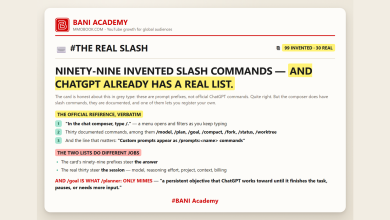
Twenty shorthand commands change the first half of that. Begin a message with /critique, /study-plan or /hook-generator and the assistant knows what kind of help you want before it reads the rest. They are not buttons, and nothing is installed – they are shorthand that works because the meaning is obvious enough to follow.
The second half is the part almost nobody does: taking the one you use most and saving it as a Skill. Write out exactly how you want that job done – your tone, your format, your rules – once. After that it happens that way every time, without you typing any of it.
The promotion path, in four stages
A command is not born fully written. It goes through the same four stages, and the last one is where the value is.
| 1. Ad hoc → | 2. Repeated → | 3. Written down → | 4. Promoted to a Skill |
|---|---|---|---|
| You type the request A sentence, different every time |
Third time this month Now it is a pattern, not a one-off |
A defined instruction Quantity, order, one exclusion, stored where chats see it |
Your standards, once Tone, format, rules, examples – followed every time without typing them |
| “Write me some opening lines” | Typed weekly, results all over the place | /hook-generator, defined: five hooks, under twelve words, no questions | A hook Skill holding your channel’s promise, banned phrases and three examples that worked |
The distinction between stages three and four is worth being precise about. A shortcut is a label – a short name for an instruction. A Skill is the instruction itself, stored properly: long enough to hold your standards, your structure and a couple of worked examples, and reused automatically when the job comes up.
The twenty, grouped by what they are for
Here is the full set, sorted into families, with an honest view of which ones deserve to be written up properly.
| Family | Commands | What it is for | Worth promoting to a Skill? |
|---|---|---|---|
| Learning | /expert, /explain-like-5, /deep-research, /study-plan, /mock-test | Understanding something new | Rarely – the topic changes every time |
| Sharpening work | /critique, /improve, /summarize, /step-by-step | Your own drafts and plans | Yes – /critique, once your standards are written |
| Weighing options | /compare, /competitor-analysis | Choosing between two things | Sometimes, if your criteria are fixed |
| Career | /career-coach, /resume-review, /job-description, /act-as-interviewer | Job hunting and hiring | No – occasional by nature |
| Business | /business-idea, /marketing-strategy | Planning and positioning | No – needs fresh judgement each time |
| Content | /viral-content, /hook-generator, /content-calendar | Publishing on a schedule | Yes – these are the weekly ones |
The pattern is clear enough. Anything you do weekly, to your own standards is worth a Skill. Anything occasional, or that depends on fresh judgement each time, works better as plain shorthand – and some things should not be automated at all, which we argued in most people use AI to draft.
The post this came from
Watch the reel
All twenty commands on one card, and the note about saving your favourite as a Skill. Posted on the BANI Academy page.
What goes in the Skill, and what stays in the message
This is where most attempts go wrong. People either put everything in the message, which is the situation they were trying to escape, or bury today’s details in the Skill, which then produces the same answer for every video.
| The ingredient | Where it lives | Example | Why |
|---|---|---|---|
| Your standards | In the Skill | “Never promise something the video does not deliver” | It is true of every hook you will ever write |
| The format | In the Skill | “Five options, numbered, under twelve words each” | You want the same shape every time |
| What to avoid | In the Skill | “No questions as hooks. No ‘in this video’’ | Exclusions are what stop drift |
| Worked examples | In the Skill | Three hooks from videos that did well | Examples teach tone faster than adjectives |
| Today’s topic | In the message | “This one is about free AI tools for editing” | It changes every time, by definition |
| Length, deadline, audience for this piece | In the message | “Short video, for beginners” | Situational, not permanent |
The examples row does more work than people expect. Three real hooks that performed well teach an assistant your voice better than a paragraph of adjectives ever will – and it is also how you stop getting the generic internet version of your niche. The same logic underpins picking one line from five in draft five, record one.
Where a Skill lives depends on your setup. In the chat app, standing instructions inside a project do most of this job – the ten-minute version is in stop re-explaining yourself. In the developer tool, a Skill is a file you keep with the work. Either way the principle holds: the permanent part is written down once, and the changing part is what you type.
The test before you promote anything
Writing a Skill takes half an hour, which is cheap unless you do it fifteen times for jobs you never repeat. Three questions decide it, and all three have to be yes.
Did I do this exact job three times in the last month? Not something similar – the same job, with the same kind of input and the same kind of output. Two is a coincidence; three is a pattern.
Do I know what a good result looks like? If you cannot describe the difference between an answer you would keep and one you would redo, the Skill will simply encode your uncertainty. Do the job by hand a few more times first.
Is the judgement in the instructions, not in the moment? Choosing which video to make next requires weighing things that change weekly, so no Skill can hold it. Writing five hooks to a fixed standard does not. The first stays a conversation; the second becomes a Skill.
Three yeses and it is worth the half hour. Anything else stays as plain shorthand, which costs nothing and is easy to abandon.
Three worth promoting on a channel
If you make videos every week, three of the twenty are obvious candidates.
/hook-generator. Your Skill holds what your audience already knows, the phrases you never use, and three openings that worked. You supply the topic. This is the one with the largest effect per minute of setup, because the first ten seconds decide most of the watch time.
/critique. Write down what a good script of yours looks like – one idea per section, claims backed, no filler before the first point – and the critique stops being generic advice and starts being your editor. Add “no compliments”, or you will get a paragraph of encouragement before anything useful.
/content-calendar. Put your pillars, your upload rhythm and your no-go topics in the Skill. Then a month of ideas arrives already shaped like your channel, instead of a list of things that trend for everyone. Demand still has to be checked separately, as in AI keyword ideas, then verify demand and demand first.
Start with one. A Skill you actually trigger weekly is worth more than five you wrote in an enthusiastic afternoon – the same lesson as the audit in thirty-one retypes, where the sentences you repeat most are the only ones worth formalising.
Frequently asked questions
Are these commands built into Claude?
No. They are shorthand that works because the meaning is clear. Skills are a real feature; the twenty command names are not.
How long should a Skill be?
Long enough to hold your standards, format, exclusions and two or three examples. Usually half a page, not five.
Can I have too many?
Yes. A Skill you never trigger is clutter. Three well-written ones beat twenty half-written.
What if the output still drifts?
Something permanent is missing from the Skill, or something situational crept into it. Read both halves again before blaming the model.
Promote one this week
Pick the command you typed most this month. Write half a page: what it does, the format you want back, two things it must never do, and two examples of the output you would have kept. Save it where your assistant can see it, then use it for a week and tighten whatever annoyed you.
The real power is not asking questions. It is deciding, once, how you want them answered.
Learning a lot does not make anyone good. Doing a lot does.
If you want the structure that turns that into a habit, that is what our free challenge is built for: no barrier to entry, a genuine commitment to action, and a refundable commitment fee you get back when you finish. You are not paying for the knowledge. You are betting on yourself finishing, and we hold the stake.
Which one will you try first? Comment the number on the original reel.
For more on building channels for English-speaking audiences, that is what we work on at mmoyoutube.com.